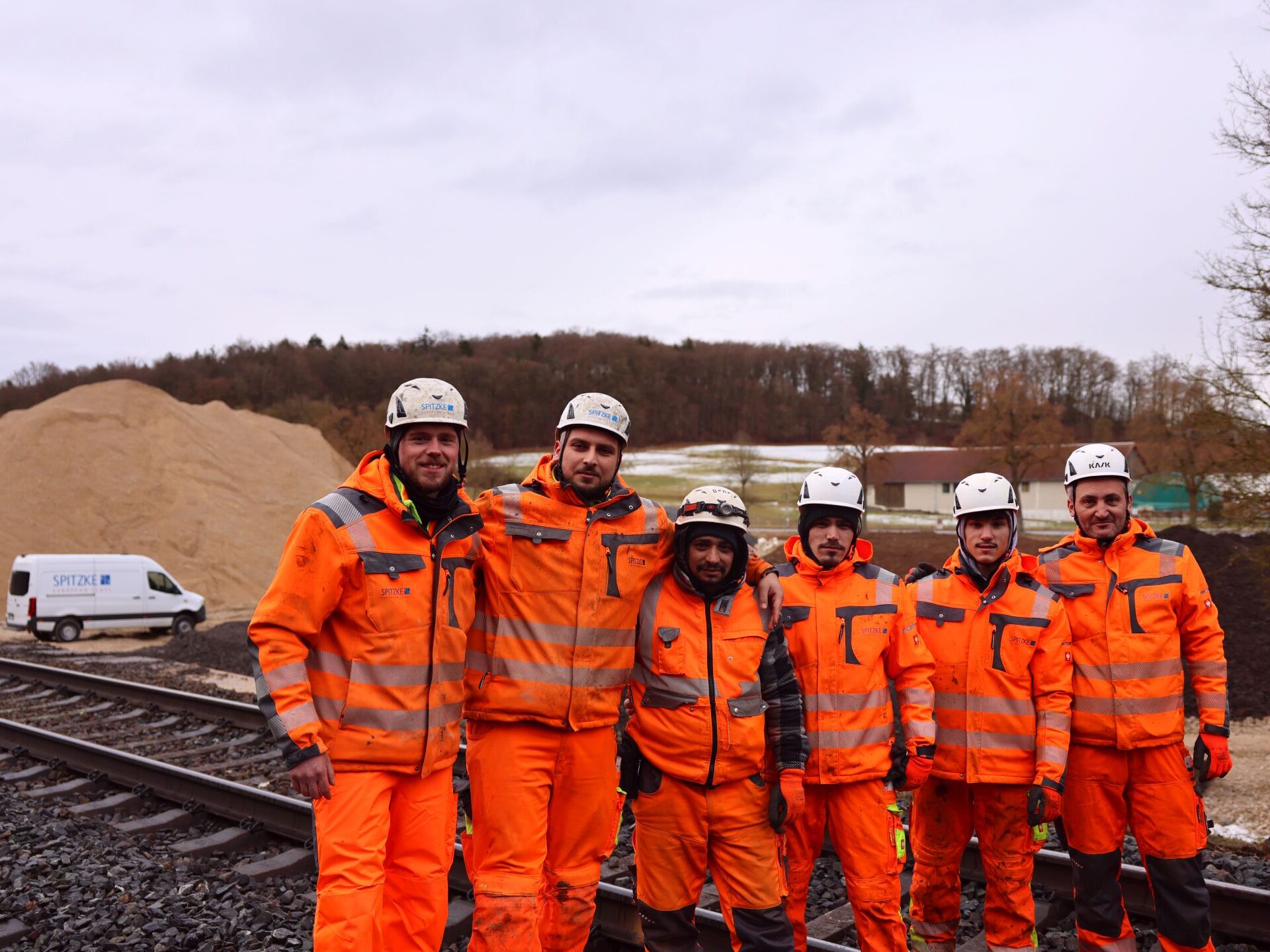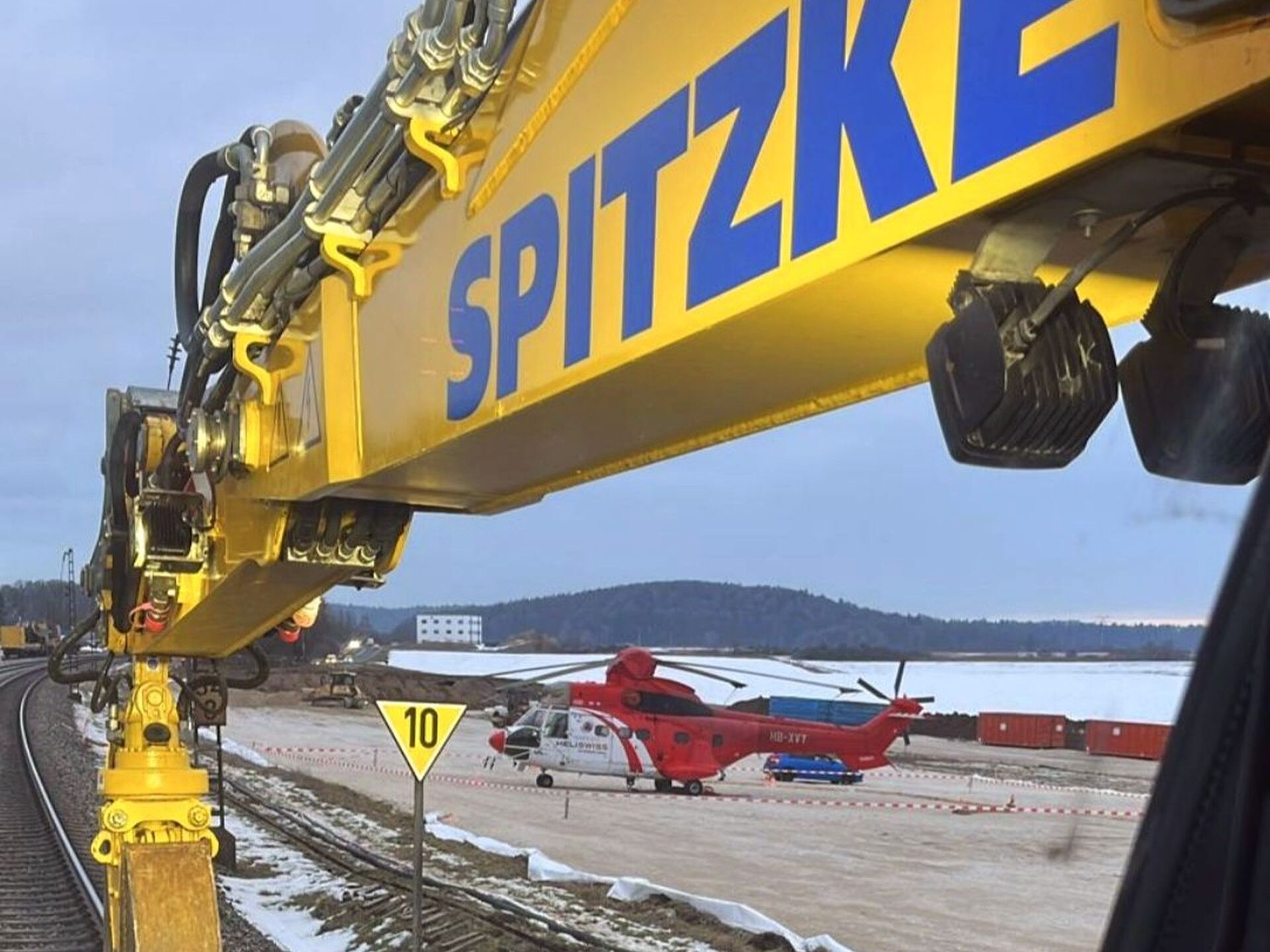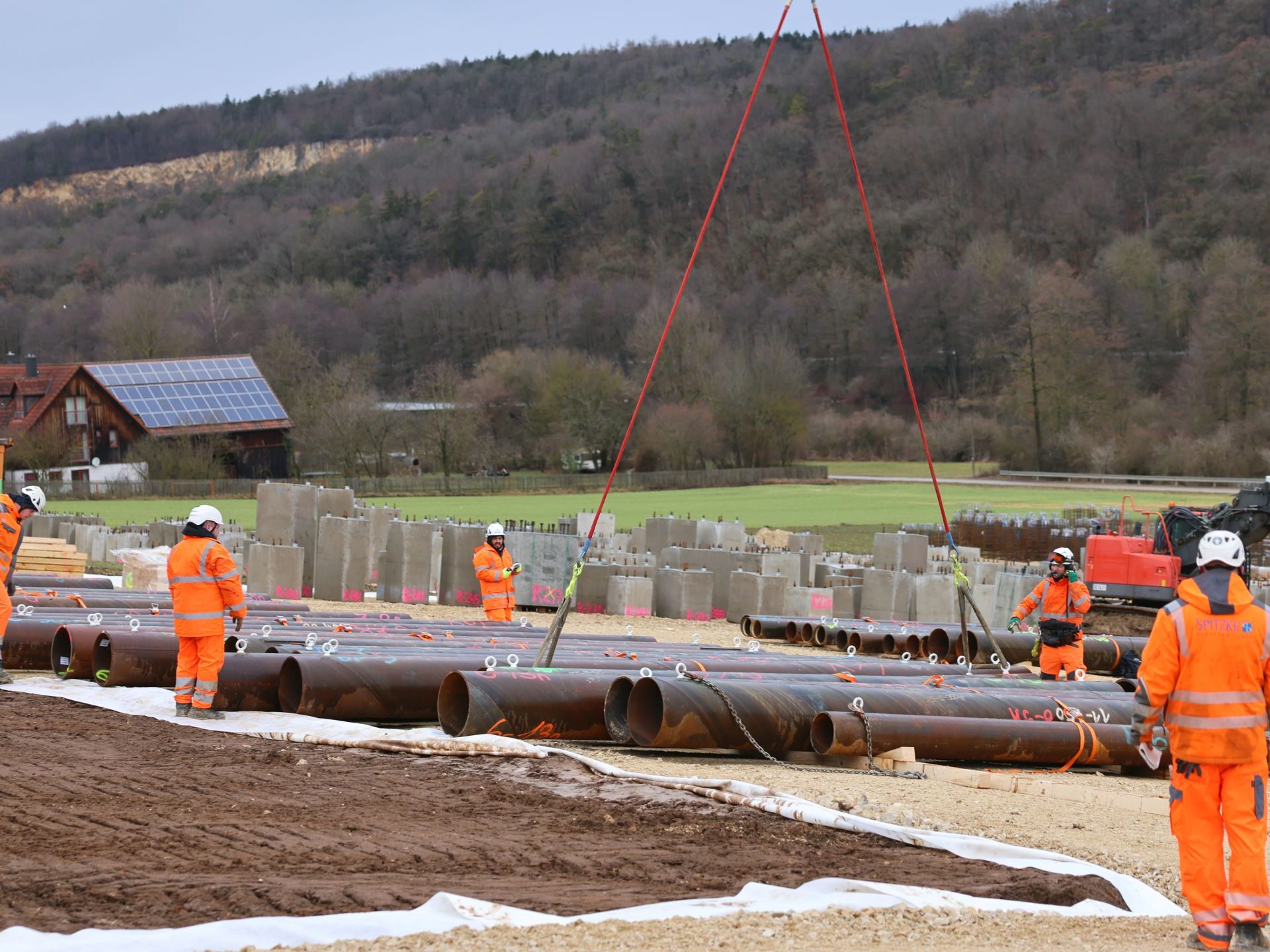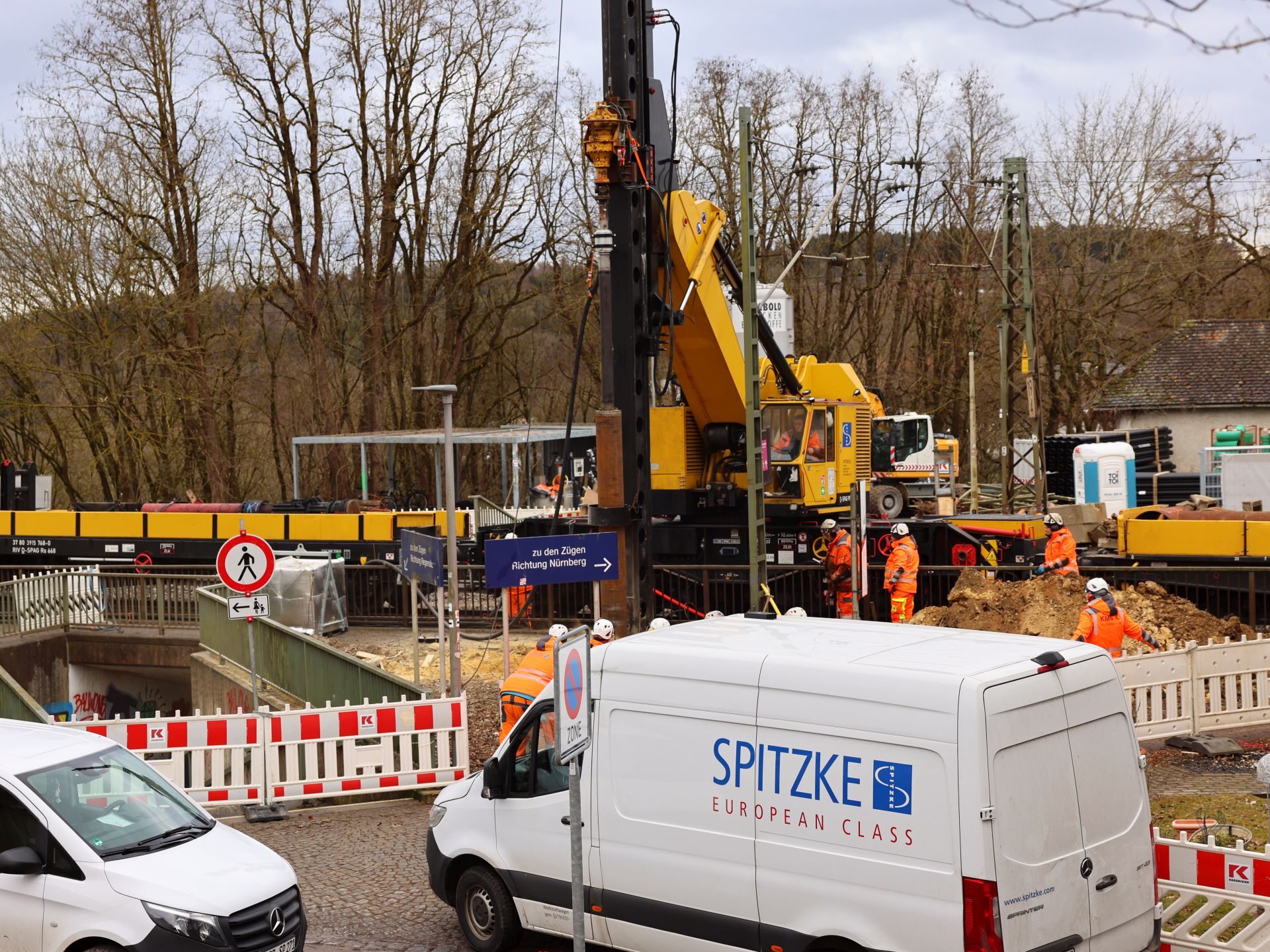

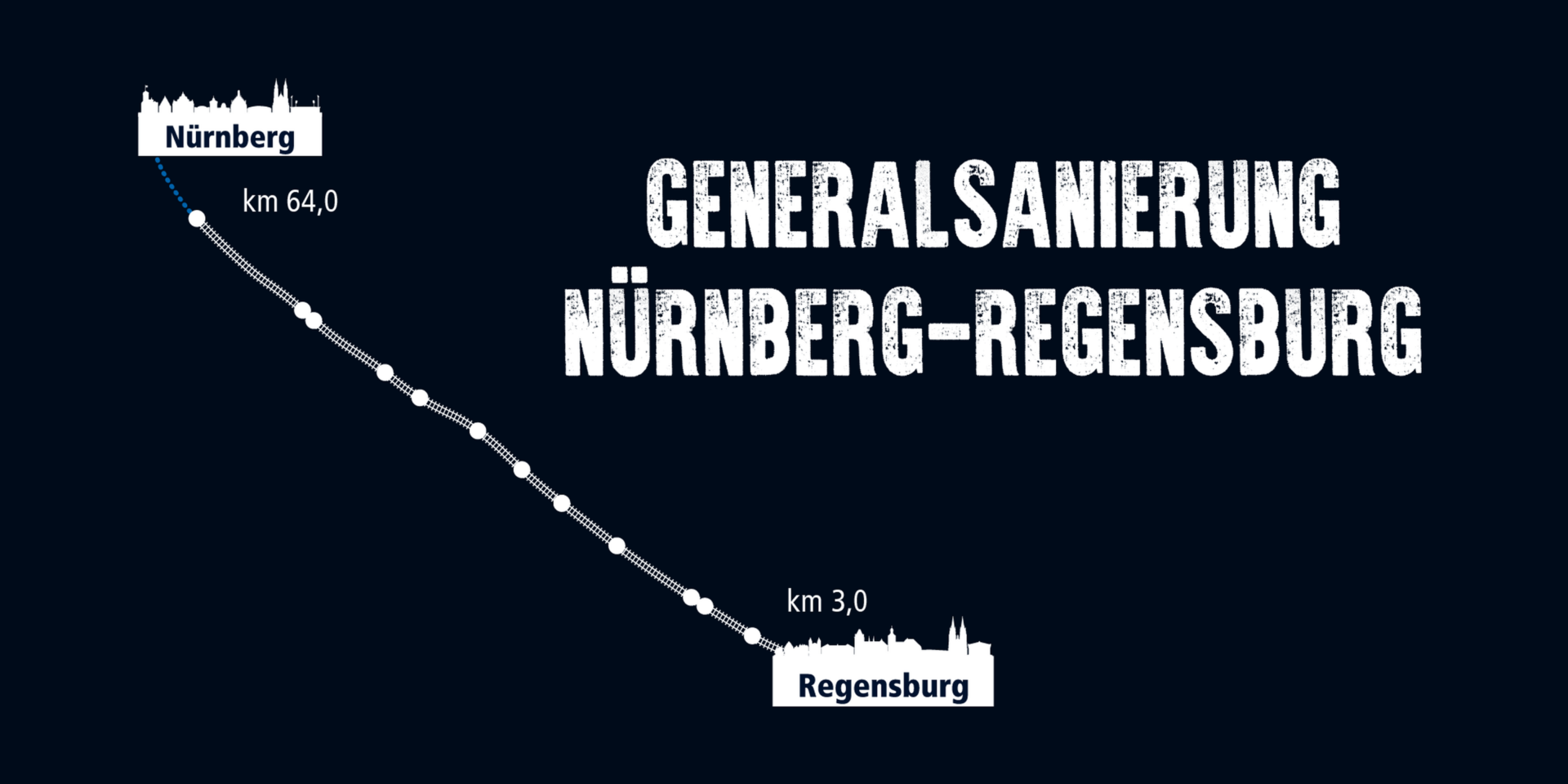
The entire route from Nuremberg to Regensburg is approximately 88 km long and will undergo a complete general overhaul from 6 February to 10 July 2026. We have been commissioned for Construction Phase 1 from Regensburg to Neumarkt and are carrying out the comprehensive renewal of this section as the main contractor. This means that all construction work on this section falls within our area of responsibility. The project is being managed by our Southern Competence Centre in Buchloe, with many sites and business divisions, as well as all the expertise within the group, involved in its implementation.
Within the Nürnberg–Regensburg corridor project, a huge amount of work is to be carried out in just a few weeks. On the 61 km section between Regensburg and Neumarkt, we are renewing the track infrastructure and, on half of the route, we are also improving the subgrade. The scope of work is immense and the five-month timeframe is extremely short. The line is expected to be handed over in sections to the signalling and safety systems contractor from May onwards. By then, our main works must already be completed.
#TeamNürnbergRegensburg: Our hashtag on social media.
Update #14 – June 23th, 2026
Our teams have done a great job: Our work on the track bed, foundations, and overhead line construction has been completed on schedule. But a large project like this also entails many additional tasks that were not yet determined when construction began. Due to a large number of additional services and a significant increase in the scope of work, some tasks remain to be done.
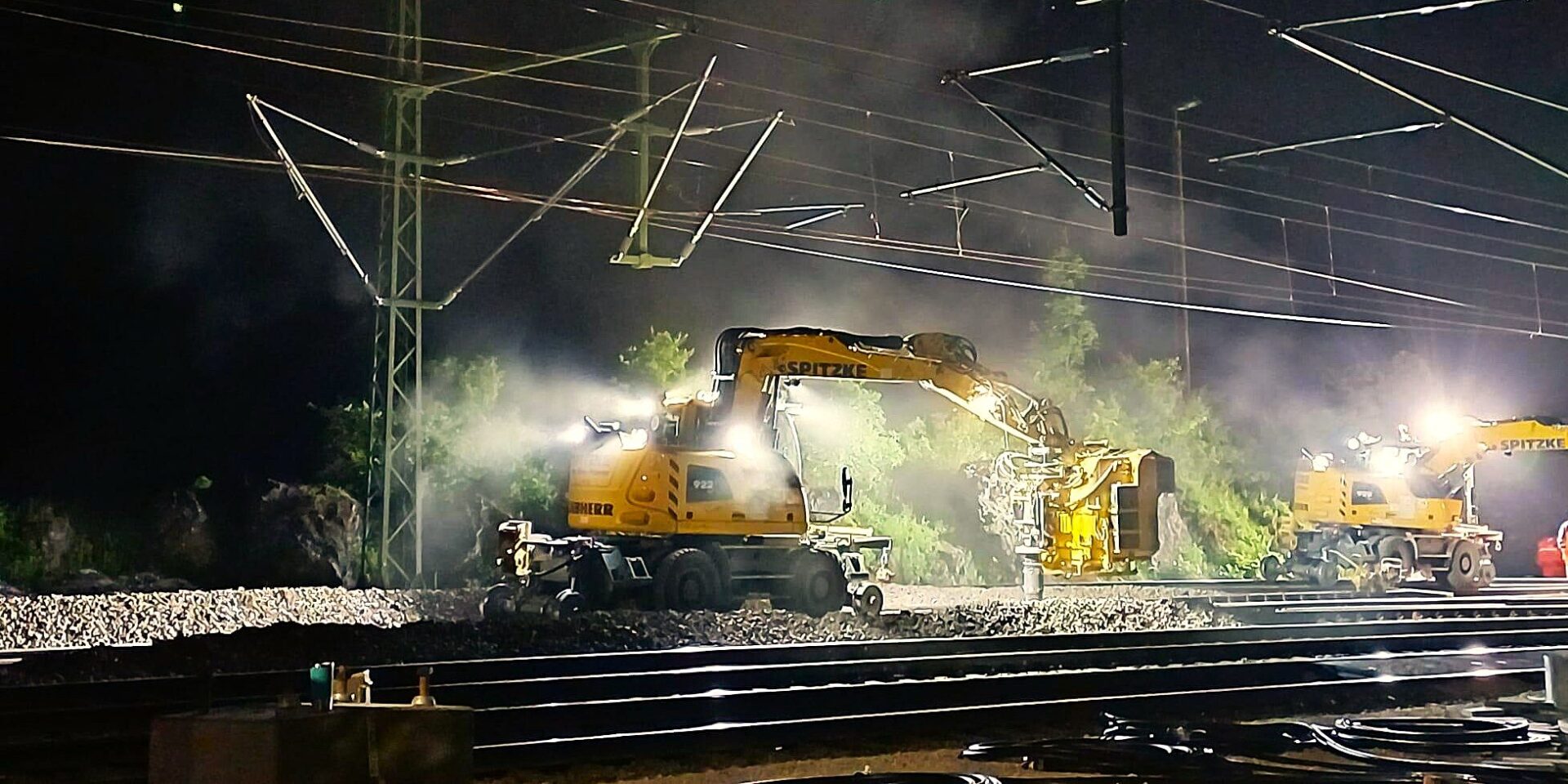
The cable pulling, 50-Hertz, and LST trades are currently under particular pressure as they work continuously towards a successful commissioning. Inspections for commissioning are currently taking place across all trades. Things are getting tight in the signaling technology sector. Here, we have prepared the outdoor installations for the new signal boxes. To stay on schedule, we are supporting Deutsche Bahn in all LST areas: installing new signals, relocating old signals, laying cables in the distribution cabinets, measuring the old existing cables, replacing the old cables, and quickly installing cable crossings. Most recently, we even took care of removing wasp nests from signal systems.
Update #12 – May 8th, 2026
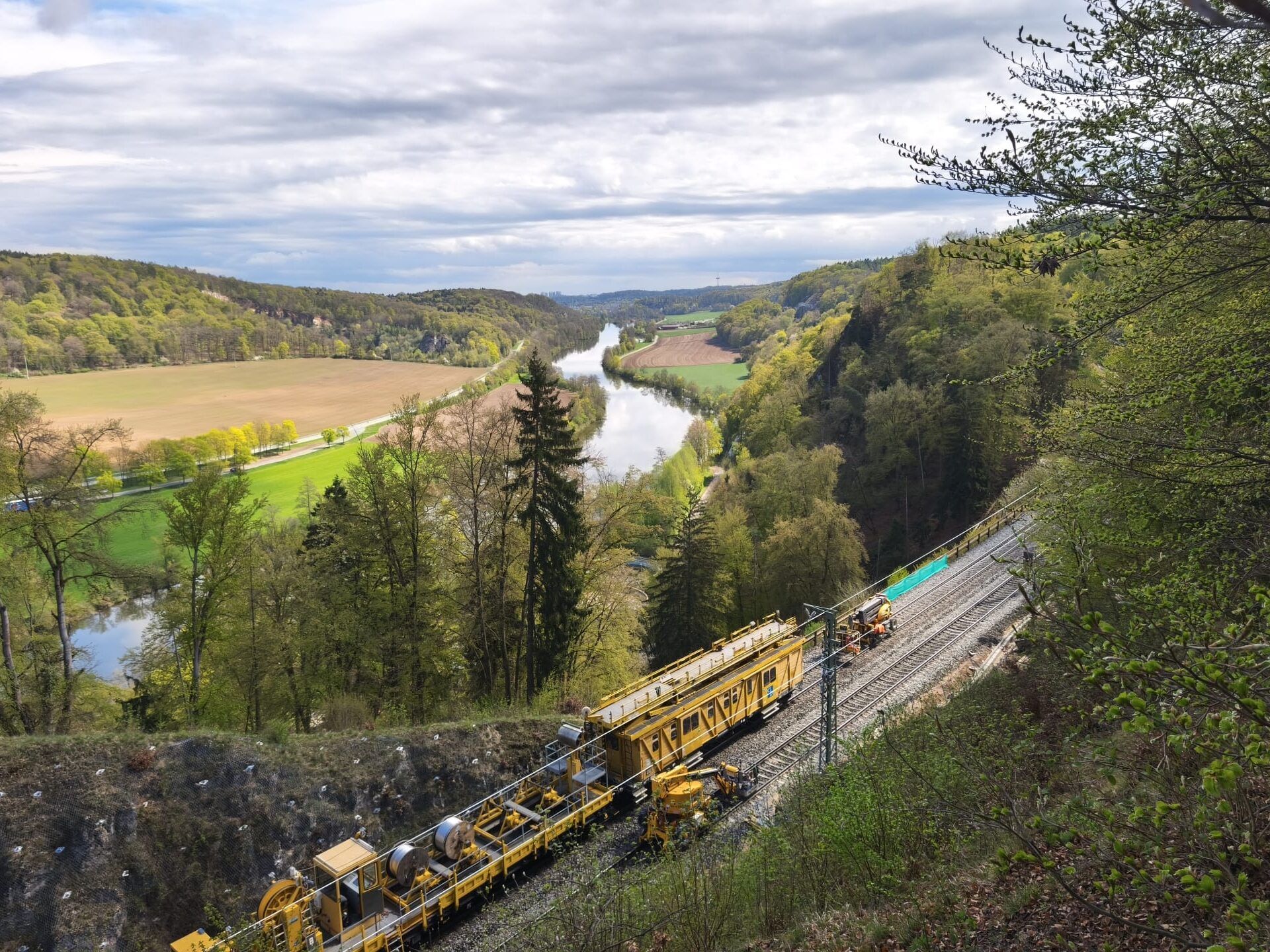
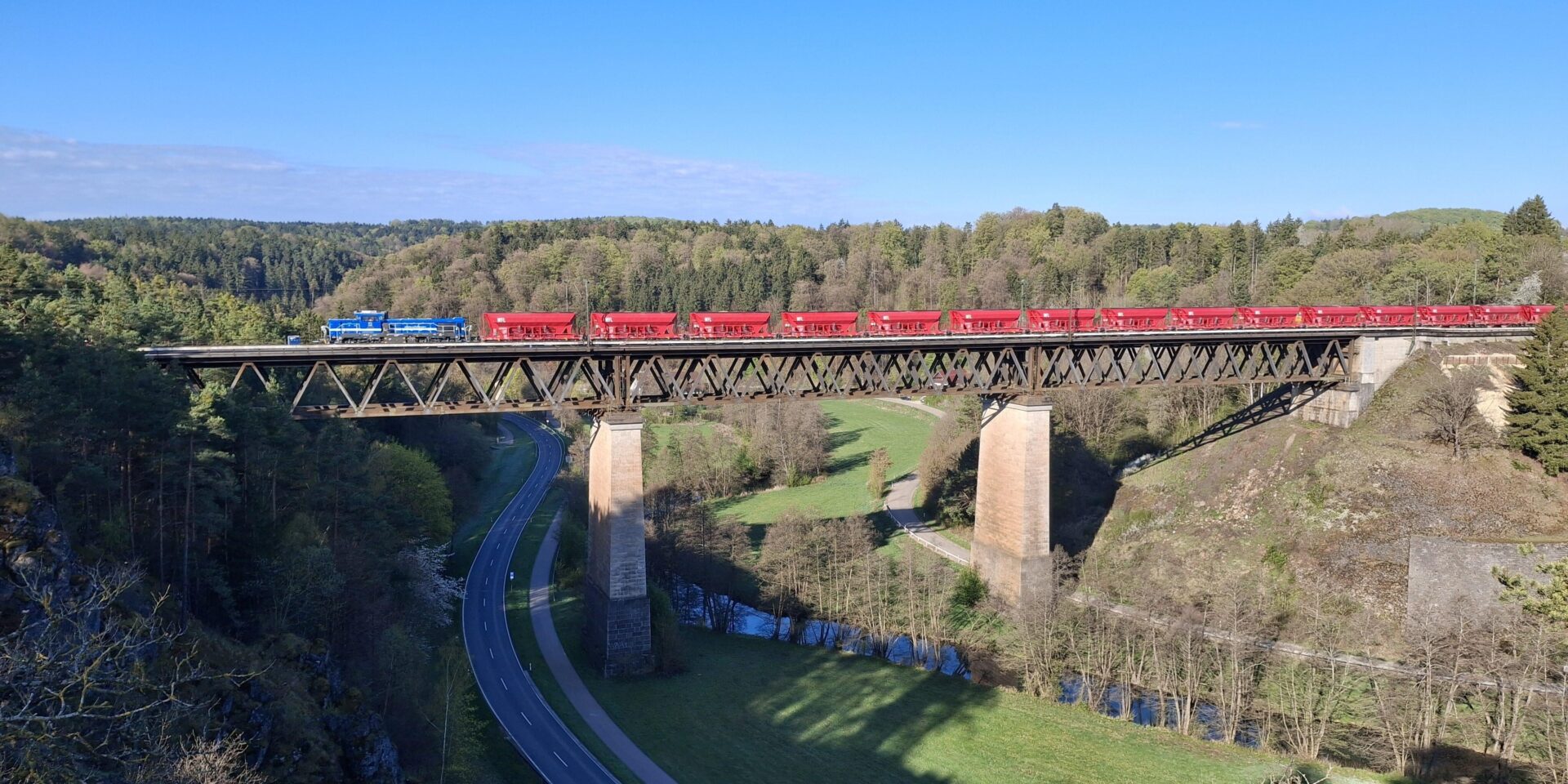
High above Laber Valley, SLG is transporting materials to the construction site. The corridor modernization of the Nuremberg-Regensburg line also includes renewal work on the railway bridge spanning the Schwarze Laber. Over the past several weeks, our teams from the Buchloe branch have been replacing the bridge girders on the 42-meter-high Laber Viaduct. Wind, frost, and snow made this work on the bridge extremely challenging. For the duration of the rehabilitation work, the structure was fitted with a protective safety net. Our Buchloe colleagues, and likely the locomotive engineers of SLG, probably had little opportunity to enjoy the breathtaking views and beautiful surrounding landscape. Many thanks to our site manager from Buchloe for this outstanding photograph!
Update #11 – April 30th, 2026
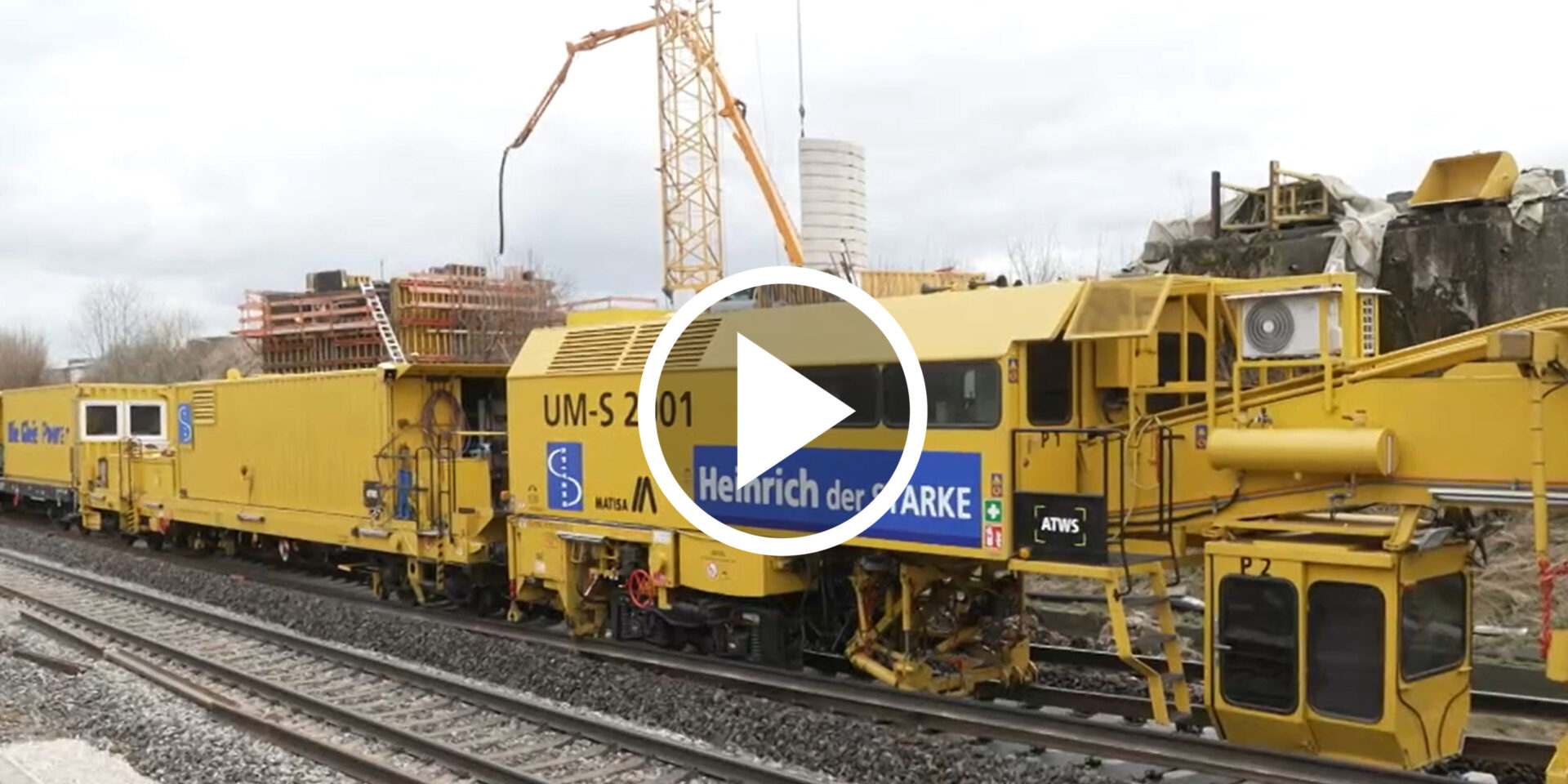
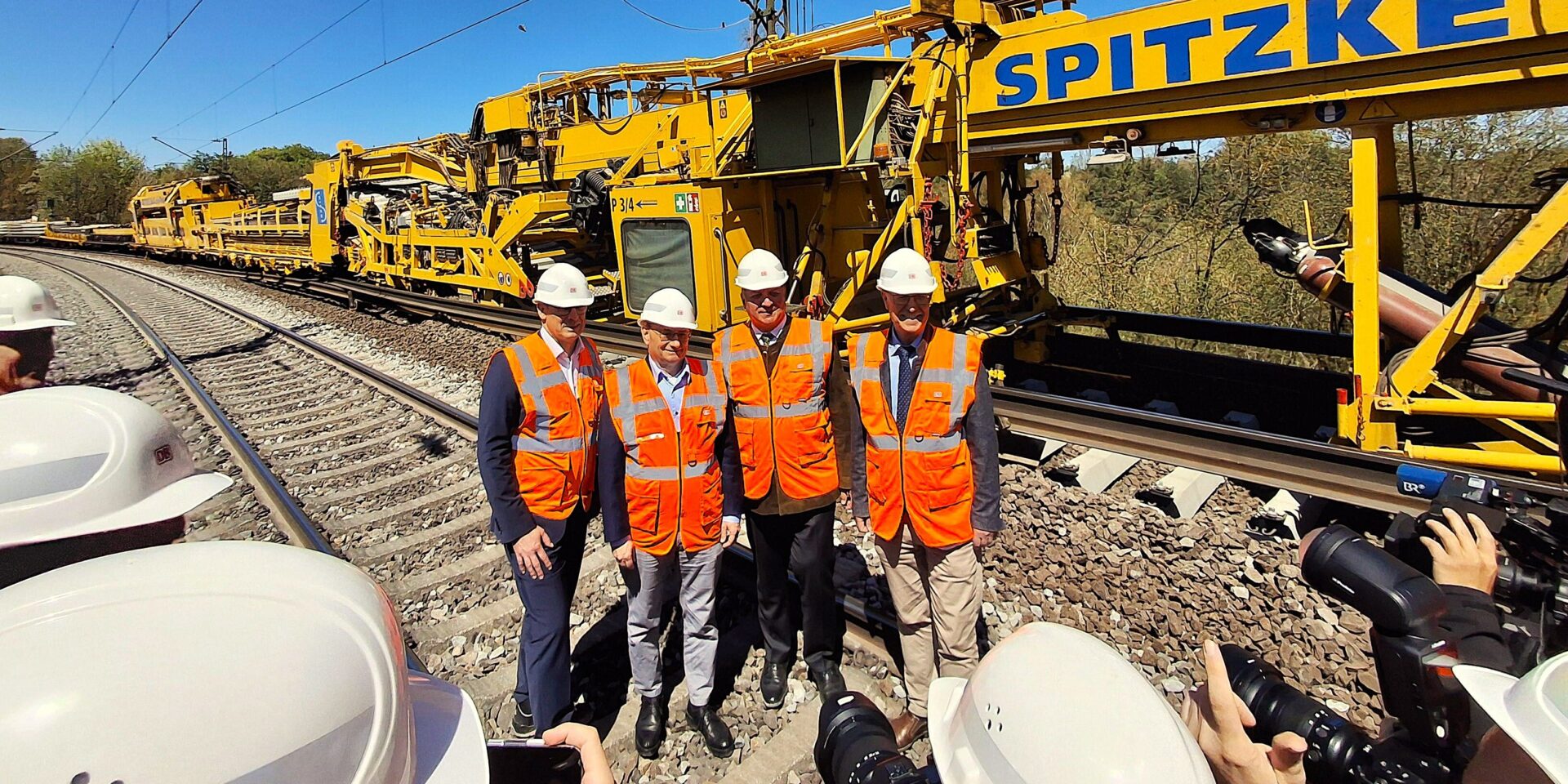
The last sleeper has been installed. Of course, additional sleepers will still be replaced between Nuremberg and Regensburg, but today Heinrich the Strong completed his final shift. The mechanized rail and sleeper replacement using our UM-S 2001 track renewal train has been completed halfway through the construction period of this major project in the Upper Palatinate.
The final shift of Heinrich the Strong was witnessed by Ulrich Lange, Parliamentary State Secretary to the Federal Minister for Transport, Bavarian Minister of Transport Christian Bernreiter, and DB InfraGO Executive Board Member Gerd-Dietrich Bolte.
Together with representatives from the press, they visited the site to learn about the current status of the work after about 2 and a half months of construction. Tomorrow, Katharina die Große, our track formation rehabilitation and cleaning machine, will once again go into operation. However, that is not everything. Progress on the corridor modernization continues at a rapid pace, and additional milestones will be reached in the coming weeks. We will keep you updated.
Update #9 – April 2nd, 2026
The comprehensive modernization of the Nuremberg–Regensburg line remains on schedule. Challenges and isolated delays are being successfully mitigated. Our teams have now been working between Regensburg and Neumarkt for nearly eight weeks, and approximately one-third of the construction period has been completed. The challenging rocky subsoil continues to present significant demands, particularly for our foundation teams (see below). Despite these conditions, our team recently completed its 1,000th foundation.
Overview of the current status of our 7 technical lots (selected highlights):
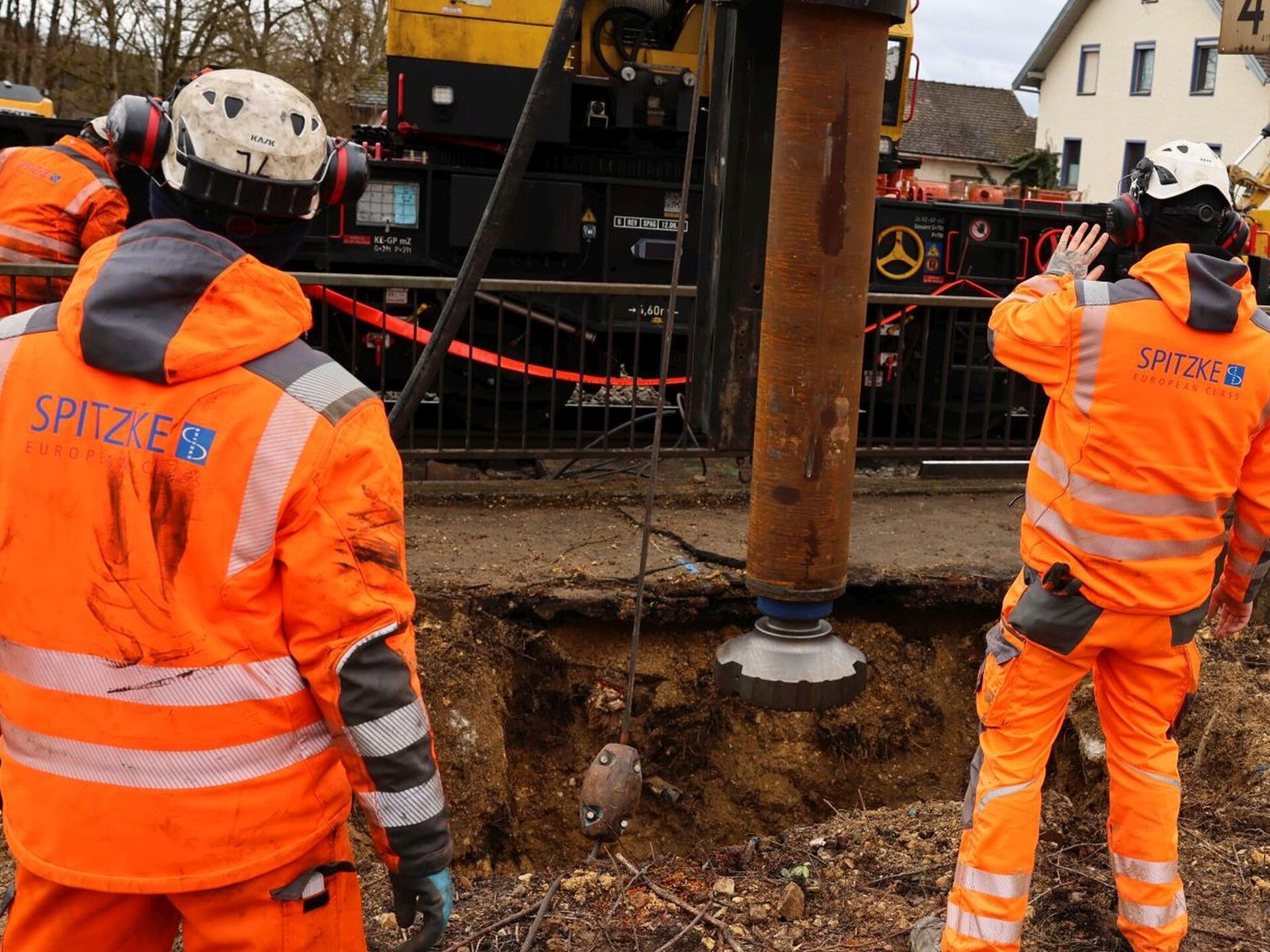
An outstanding achievement by teams from across the entire Group and by our subcontractors. As reported several times before, the ground conditions alongside the line are extremely rocky. Despite extensive soil investigations, we have encountered harder rock formations than originally anticipated. The slight delay in foundation work is primarily due to the fact that our civil engineering specialists frequently have to switch their equipment from pile driving to drilling operations. Installing a foundation using the down-the-hole drilling method takes approximately four times longer than a driven pile foundation.
Thanks to the commitment, expertise, and close collaboration of our teams, challenges and unforeseen circumstances are being addressed with a strong focus on solutions. What applies to the project as a whole is particularly evident in the demanding foundation work. Delays have been minimized and will be made up for during the installation of the overhead line system.
➡️ Here is an interesting project recap from Deutsche Bahn: TO THE VIDEO
Update #8 – March 15th, 2026
Loading sand, gravel, and crushed stone. The track formation protection layer (PSS) material being newly installed as part of the comprehensive modernization of the Nuremberg–Regensburg line consists of natural aggregate blends. The PSS is installed between the subgrade and the ballast bed and serves several important functions. It distributes loads, provides frost protection, drains water, and separates the ballast from the soil. As such, it is an essential component in ensuring the load-bearing capacity of a track’s superstructure. Our operators of the MFS cars (Material Conveying and Silo Cars), construction equipment operators responsible for managing the supply areas, and many others work together to ensure that the required materials are available at the right place and at the right time.
Update #7 – February 17th, 2026
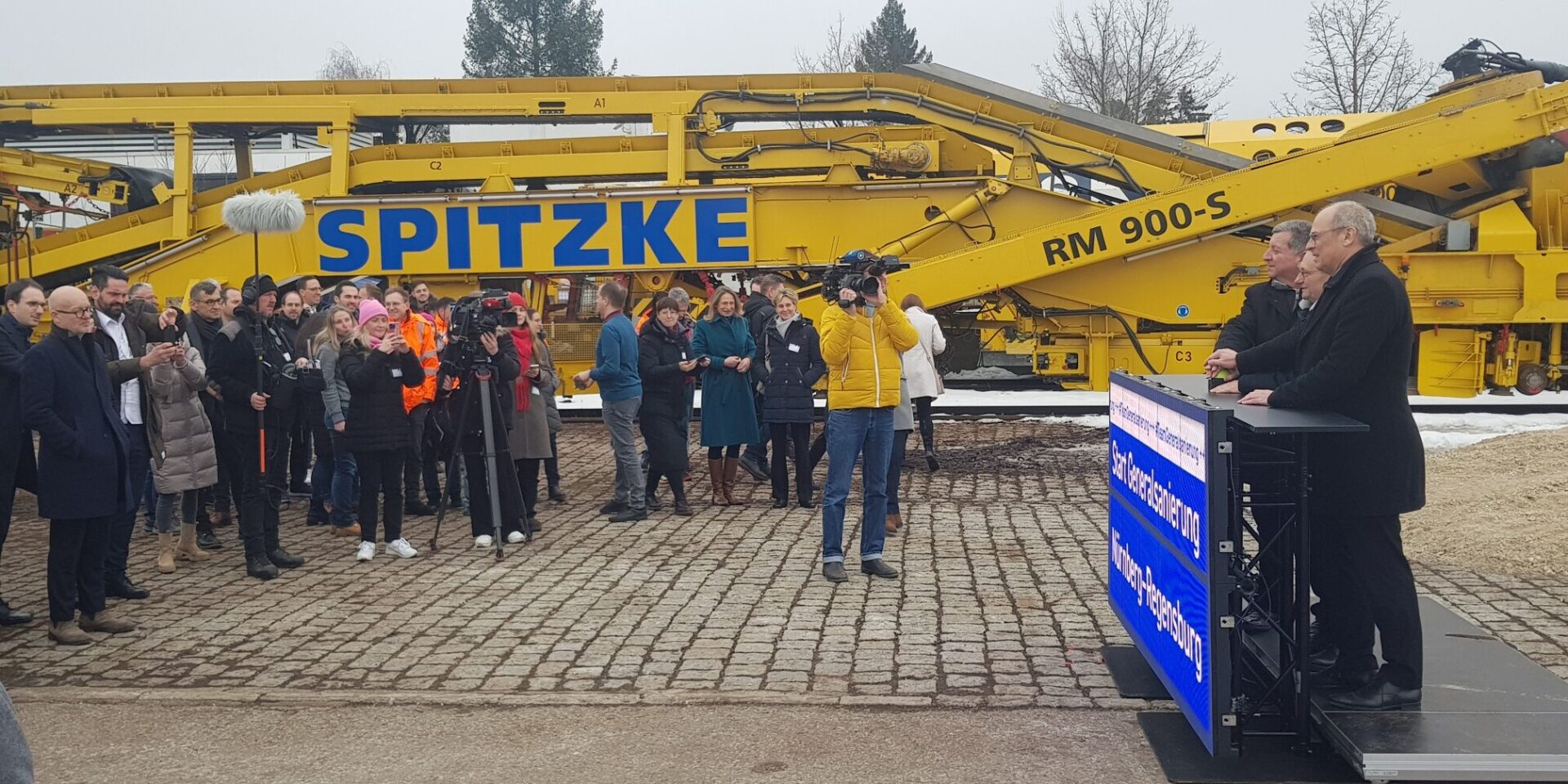
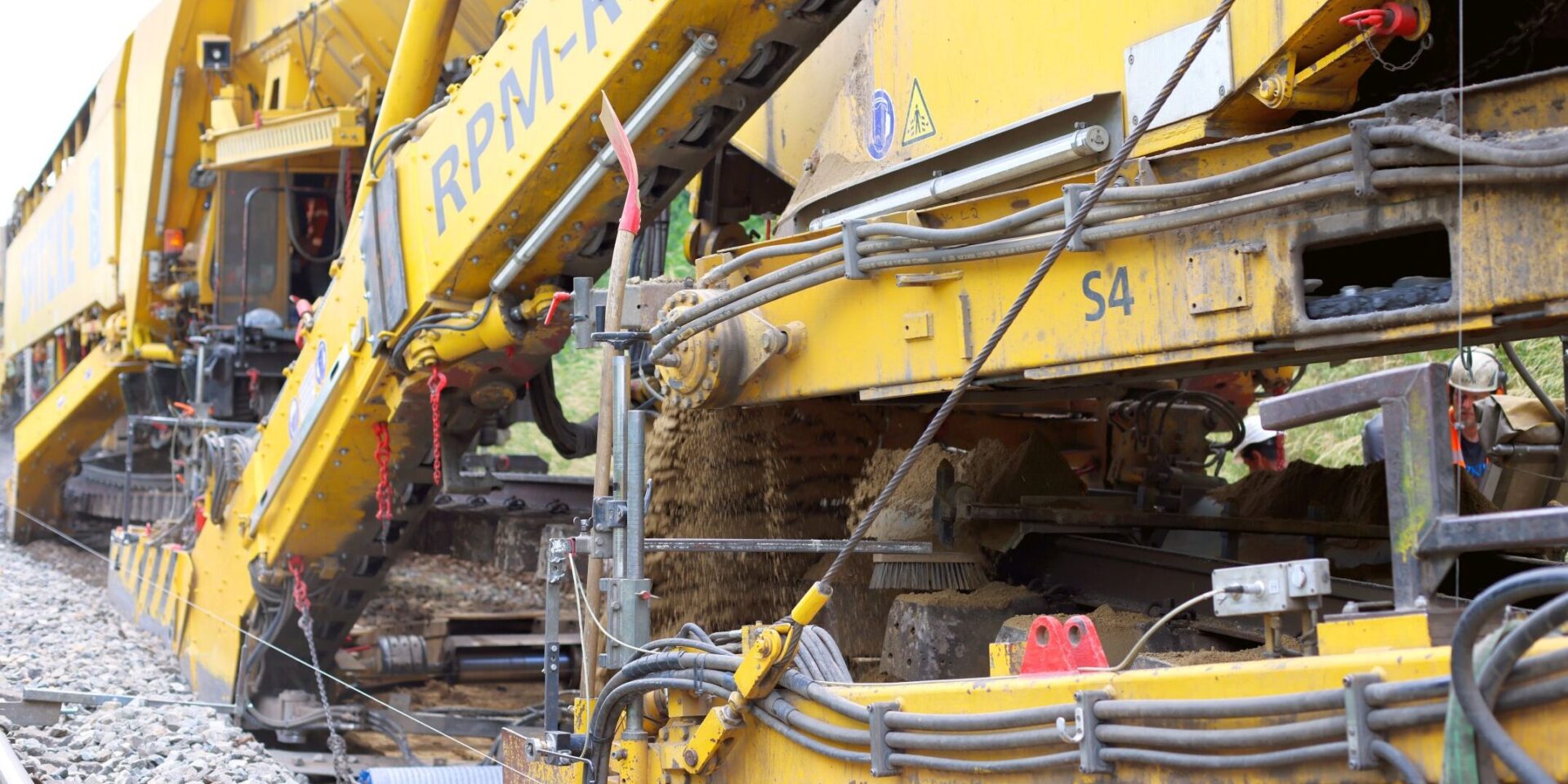
At the invitation of the client, numerous members of the press and journalists visited the project to observe construction progress firsthand. In Sengenthal and Seubersdorf, our project managers, together with representatives from DB InfraGO and the construction supervision team, answered questions and provided updates on the project. Particular interest was on our RPM-RS-900 track formation rehabilitation and cleaning machine, known as Katharina the Great.
This unique machine removes the ballast, recycles it, and feeds it back into the track together with new ballast. The outstanding capability of the 200-meter-long machine is that, at the same time, it excavates the subgrade and installs, grades, and compacts the new track formation protection layer.
Update #6 – February 14th, 2026
Our teams quickly settled into their work, and all technical areas are making good progress. After just one week, the following work has already been completed:
Update #5 – February 6th, 2026
After months of intensive preparation, planning, and coordination, the thumbs up has been given for the extensive modernization work. Together with the Board of DB InfraGO and representatives from the Federal Ministry of Transport and the Bavarian State Chancellery, we officially launched the construction work with a symbolic buzzer. Starting immediately, unlike the de-energized overhead line system, our teams are energized and ready to work hard over the next 22 weeks.
Together, we will draw on all of our expertise, experience, and technology to achieve these ambitious goals. We wish everyone involved a successful start, every success, and strong collaboration throughout the project.
Update #4 – January 9th, 2026
Only four weeks to go: With the start of the new year, preparations have intensified once again. The critical phase is now beginning, and the focus is on preparing for the project launch as effectively as possible while accommodating any changes. In numerous discussions with the client, the construction schedule for all trades is being finalized. This also includes the many additional work packages, such as the 19 signal brackets currently planned, compared to the three which were originally anticipated.
Over the coming weeks, tens of thousands of tons of material will be transported to the Upper Palatinate region. Despite the winter weather conditions, the site installation areas must be completed, and navigation points designated and signposted to successfully manage this logistical challenge. The anticipation is growing, and we are keeping our fingers crossed.
Update #3 – December 10th, 2025
Preparations for the comprehensive modernization of the Nuremberg–Regensburg line are in full swing. Since May, the teams at our Buchloe branch have been working to ensure that all planning data is complete and available as scheduled. The Head of Cost Estimating serves as the central point of contact with the client for the corridor project. Together with five additional planning coordinators, he ensures the creation of the detailed design documentation and obtains the numerous required documents from the responsible authorities and stakeholders.
The first construction crews have been active since fall of 2025, working night shifts to relocate cables, conduct unexploded ordnance surveys (UXO), and investigate subsurface conditions for the overhead line foundations.
Photo: Petr Štefek – original work, CC BY-SA 3.0 cz
Update #2 – September 9th, 2025
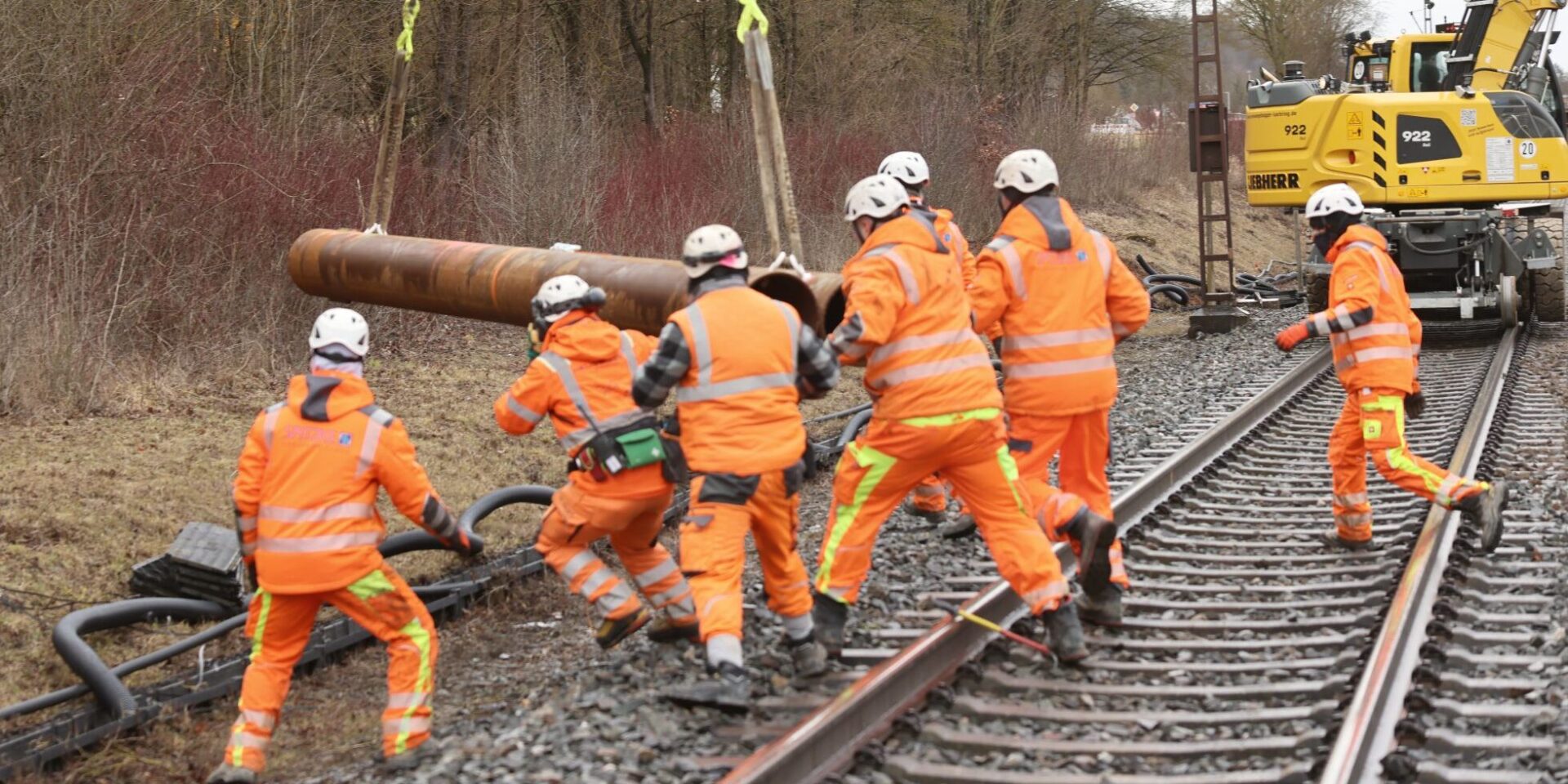
The renewal of the line will largely be carried out using an assembly-line construction method. In stations and other locations, however, conventional track renewal work will be required. Currently, approximately 5 kilometers are planned to be renewed using conventional construction methods, meaning manual reconstruction with road-rail excavators or railway cranes, including complete ballast renewal.
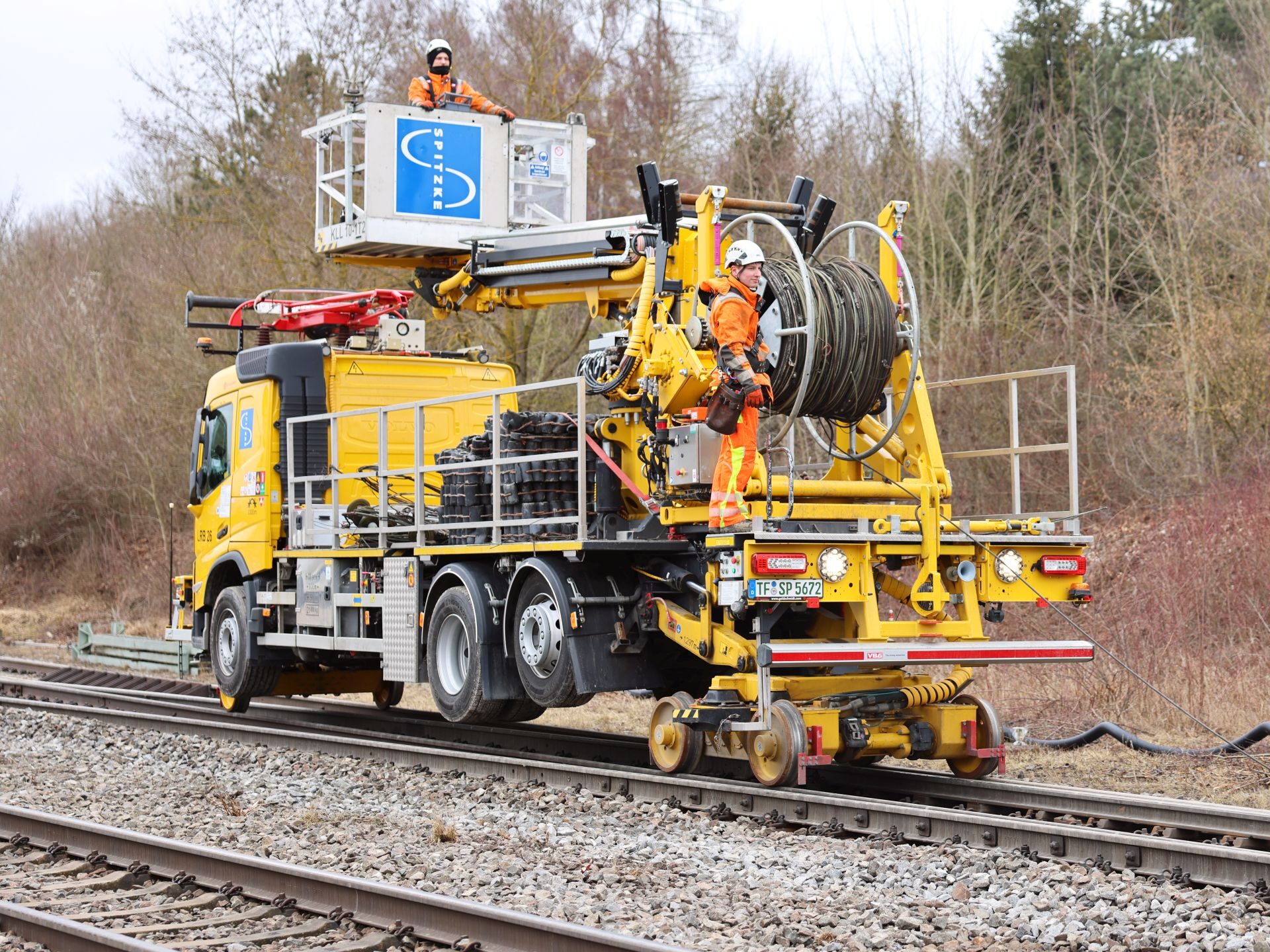
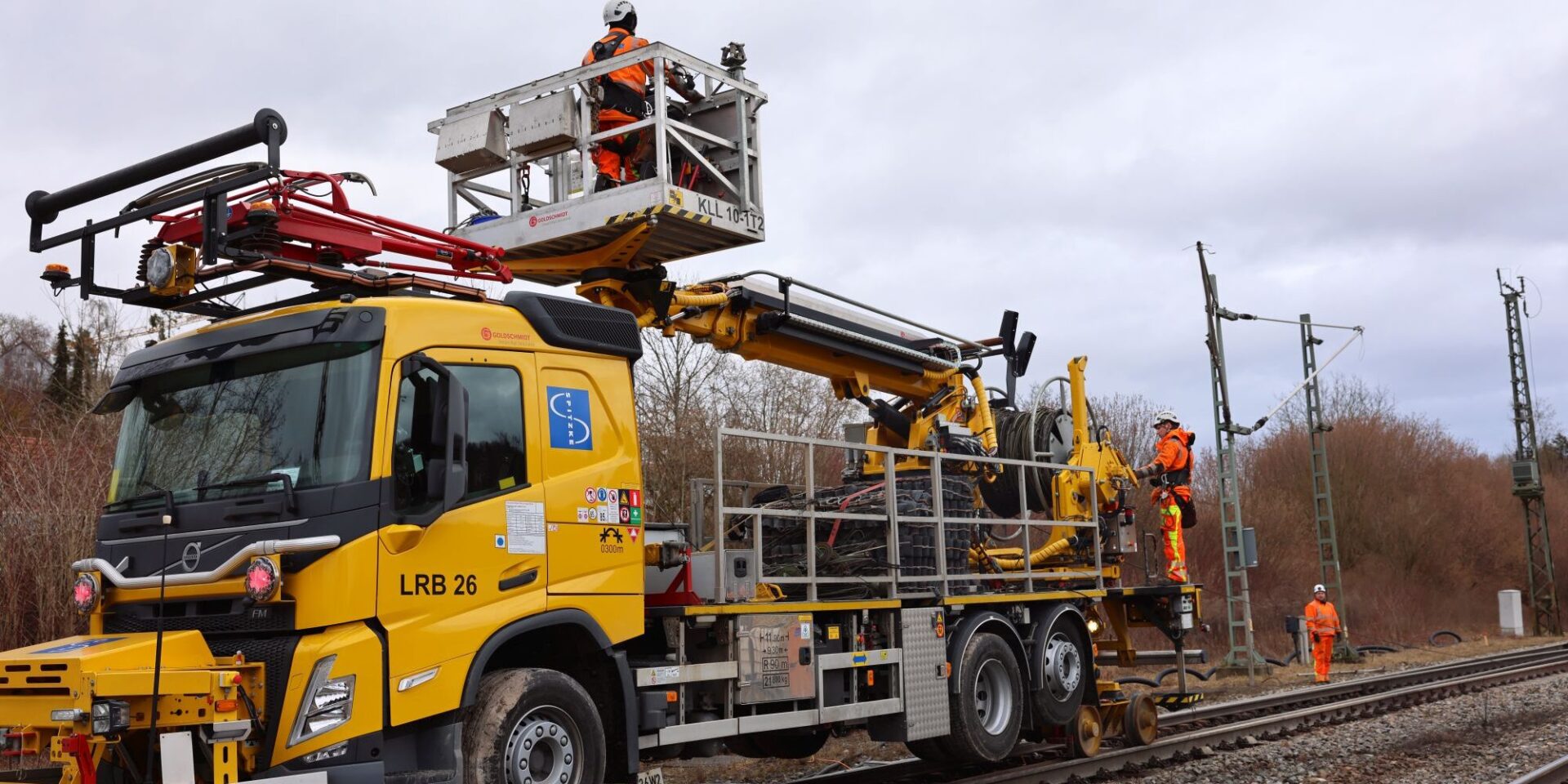
Our Equipment/Electrical Engineering division will be responsible for all electrical engineering activities. One of the most challenging tasks will be the installation of approximately 250 kilometers of cable in the newly constructed cable ducts. In addition to the complete cable management, this division will also be responsible for equipping the catenary supports. Continue reading for more information.
Update #1 – July 24th, 2025
We are preparing for the next major corridor project on the Nuremberg–Regensburg line. Line 5850, which is more than 80 km long, between Nuremberg and Regensburg will undergo a comprehensive modernization from February 6th to July 10th, 2026. As the general contractor, we have been awarded Section 1, Regensburg–Neumarkt.
Production at our manufacturing companies is currently running at full capacity: SPITZKE FAHRWEGSYSTEME GmbH in Möllenhagen is producing the foundation heads for roughly 1,000 foundations, while SPITZKE MAST- UND STAHLBAU GmbH in Naumburg is manufacturing catenary supports. Once completed, these components will be transported to staging areas along the line.
Update #14 – June 23th, 2026
Our teams have done a great job: Our work on the track bed, foundations, and overhead line construction has been completed on schedule. But a large project like this also entails many additional tasks that were not yet determined when construction began. Due to a large number of additional services and a significant increase in the scope of work, some tasks remain to be done.
The cable pulling, 50-Hertz, and LST trades are currently under particular pressure as they work continuously towards a successful commissioning. Inspections for commissioning are currently taking place across all trades. Things are getting tight in the signaling technology sector. Here, we have prepared the outdoor installations for the new signal boxes. To stay on schedule, we are supporting Deutsche Bahn in all LST areas: installing new signals, relocating old signals, laying cables in the distribution cabinets, measuring the old existing cables, replacing the old cables, and quickly installing cable crossings. Most recently, we even took care of removing wasp nests from signal systems.
Update #12 – May 8th, 2026
High above Laber Valley, SLG is transporting materials to the construction site. The corridor modernization of the Nuremberg-Regensburg line also includes renewal work on the railway bridge spanning the Schwarze Laber. Over the past several weeks, our teams from the Buchloe branch have been replacing the bridge girders on the 42-meter-high Laber Viaduct. Wind, frost, and snow made this work on the bridge extremely challenging. For the duration of the rehabilitation work, the structure was fitted with a protective safety net. Our Buchloe colleagues, and likely the locomotive engineers of SLG, probably had little opportunity to enjoy the breathtaking views and beautiful surrounding landscape. Many thanks to our site manager from Buchloe for this outstanding photograph!
Update #11 – April 30th, 2026
The last sleeper has been installed. Of course, additional sleepers will still be replaced between Nuremberg and Regensburg, but today Heinrich the Strong completed his final shift. The mechanized rail and sleeper replacement using our UM-S 2001 track renewal train has been completed halfway through the construction period of this major project in the Upper Palatinate.
The final shift of Heinrich the Strong was witnessed by Ulrich Lange, Parliamentary State Secretary to the Federal Minister for Transport, Bavarian Minister of Transport Christian Bernreiter, and DB InfraGO Executive Board Member Gerd-Dietrich Bolte.
Together with representatives from the press, they visited the site to learn about the current status of the work after about 2 and a half months of construction. Tomorrow, Katharina die Große, our track formation rehabilitation and cleaning machine, will once again go into operation. However, that is not everything. Progress on the corridor modernization continues at a rapid pace, and additional milestones will be reached in the coming weeks. We will keep you updated.
Update #9 – April 2nd, 2026
The comprehensive modernization of the Nuremberg–Regensburg line remains on schedule. Challenges and isolated delays are being successfully mitigated. Our teams have now been working between Regensburg and Neumarkt for nearly eight weeks, and approximately one-third of the construction period has been completed. The challenging rocky subsoil continues to present significant demands, particularly for our foundation teams (see below). Despite these conditions, our team recently completed its 1,000th foundation.
Overview of the current status of our 7 technical lots (selected highlights):
An outstanding achievement by teams from across the entire Group and by our subcontractors. As reported several times before, the ground conditions alongside the line are extremely rocky. Despite extensive soil investigations, we have encountered harder rock formations than originally anticipated. The slight delay in foundation work is primarily due to the fact that our civil engineering specialists frequently have to switch their equipment from pile driving to drilling operations. Installing a foundation using the down-the-hole drilling method takes approximately four times longer than a driven pile foundation.
Thanks to the commitment, expertise, and close collaboration of our teams, challenges and unforeseen circumstances are being addressed with a strong focus on solutions. What applies to the project as a whole is particularly evident in the demanding foundation work. Delays have been minimized and will be made up for during the installation of the overhead line system.
➡️ Here is an interesting project recap from Deutsche Bahn: TO THE VIDEO
Update #8 – March 15th, 2026
Loading sand, gravel, and crushed stone. The track formation protection layer (PSS) material being newly installed as part of the comprehensive modernization of the Nuremberg–Regensburg line consists of natural aggregate blends. The PSS is installed between the subgrade and the ballast bed and serves several important functions. It distributes loads, provides frost protection, drains water, and separates the ballast from the soil. As such, it is an essential component in ensuring the load-bearing capacity of a track’s superstructure. Our operators of the MFS cars (Material Conveying and Silo Cars), construction equipment operators responsible for managing the supply areas, and many others work together to ensure that the required materials are available at the right place and at the right time.
Update #7 – February 17th, 2026
At the invitation of the client, numerous members of the press and journalists visited the project to observe construction progress firsthand. In Sengenthal and Seubersdorf, our project managers, together with representatives from DB InfraGO and the construction supervision team, answered questions and provided updates on the project. Particular interest was on our RPM-RS-900 track formation rehabilitation and cleaning machine, known as Katharina the Great.
This unique machine removes the ballast, recycles it, and feeds it back into the track together with new ballast. The outstanding capability of the 200-meter-long machine is that, at the same time, it excavates the subgrade and installs, grades, and compacts the new track formation protection layer.
Update #6 – February 14th, 2026
Our teams quickly settled into their work, and all technical areas are making good progress. After just one week, the following work has already been completed:
Update #5 – February 6th, 2026
After months of intensive preparation, planning, and coordination, the thumbs up has been given for the extensive modernization work. Together with the Board of DB InfraGO and representatives from the Federal Ministry of Transport and the Bavarian State Chancellery, we officially launched the construction work with a symbolic buzzer. Starting immediately, unlike the de-energized overhead line system, our teams are energized and ready to work hard over the next 22 weeks.
Together, we will draw on all of our expertise, experience, and technology to achieve these ambitious goals. We wish everyone involved a successful start, every success, and strong collaboration throughout the project.
Update #4 – January 9th, 2026
Only four weeks to go: With the start of the new year, preparations have intensified once again. The critical phase is now beginning, and the focus is on preparing for the project launch as effectively as possible while accommodating any changes. In numerous discussions with the client, the construction schedule for all trades is being finalized. This also includes the many additional work packages, such as the 19 signal brackets currently planned, compared to the three which were originally anticipated.
Over the coming weeks, tens of thousands of tons of material will be transported to the Upper Palatinate region. Despite the winter weather conditions, the site installation areas must be completed, and navigation points designated and signposted to successfully manage this logistical challenge. The anticipation is growing, and we are keeping our fingers crossed.
Update #3 – December 10th, 2025
Preparations for the comprehensive modernization of the Nuremberg–Regensburg line are in full swing. Since May, the teams at our Buchloe branch have been working to ensure that all planning data is complete and available as scheduled. The Head of Cost Estimating serves as the central point of contact with the client for the corridor project. Together with five additional planning coordinators, he ensures the creation of the detailed design documentation and obtains the numerous required documents from the responsible authorities and stakeholders.
The first construction crews have been active since fall of 2025, working night shifts to relocate cables, conduct unexploded ordnance surveys (UXO), and investigate subsurface conditions for the overhead line foundations.
Photo: Petr Štefek – original work, CC BY-SA 3.0 cz
Update #2 – September 9th, 2025
The renewal of the line will largely be carried out using an assembly-line construction method. In stations and other locations, however, conventional track renewal work will be required. Currently, approximately 5 kilometers are planned to be renewed using conventional construction methods, meaning manual reconstruction with road-rail excavators or railway cranes, including complete ballast renewal.
Our Equipment/Electrical Engineering division will be responsible for all electrical engineering activities. One of the most challenging tasks will be the installation of approximately 250 kilometers of cable in the newly constructed cable ducts. In addition to the complete cable management, this division will also be responsible for equipping the catenary supports. Continue reading for more information.
Update #1 – July 24th, 2025
We are preparing for the next major corridor project on the Nuremberg–Regensburg line. Line 5850, which is more than 80 km long, between Nuremberg and Regensburg will undergo a comprehensive modernization from February 6th to July 10th, 2026. As the general contractor, we have been awarded Section 1, Regensburg–Neumarkt.
Production at our manufacturing companies is currently running at full capacity: SPITZKE FAHRWEGSYSTEME GmbH in Möllenhagen is producing the foundation heads for roughly 1,000 foundations, while SPITZKE MAST- UND STAHLBAU GmbH in Naumburg is manufacturing catenary supports. Once completed, these components will be transported to staging areas along the line.
The comprehensive general overhaul concept was first applied to the Riedbahn line in 2024 and is now also being implemented on the busy Nürnberg–Regensburg line from February to July 2026. Over the next six years, a total of 40 heavily used corridor lines, with a combined length of more than 4,000 kilometres, are to be completely general overhauled.
Main construction phase: 6 February to 10 July 2026
Objective: fewer disruptions and delays, sustainable stability and resilience of the heavily used line // improved passenger information and accessibility at stations
Line length: 88 km
Total measures include:
Genearl overhaul of 20 stations
rack renewal over 90 km
installation of 40 sets of points
Renewal or construction of approximately 80 km of overhead lines
Our services in construction phase 1 (Regensburg–Neumarkt, 61 km section) include:
60 km of track renewal using the continuous track method
30 km of subgrade improvement
5 km of conventional reconstruction including complete ballast cleaning
22 sets of points
8 signal boxes
2 railway bridges
80 km of catenary
60 km of feeder lines
250 km of cable laying
1,100 pole foundations
1,200 catenary masts erected and fitted out
30 km cable duct
63 km track-side path
3 km deep drainage
7 km drainage slits
66 manholes
1,700 welds
132 km of rail unloaded
280,000 t of rubble
#TeamNürnbergRegensburg
Press contact
Kristin Gebhardt
Telefon: +49 33701 901-20163
E-Mail: kristin.gebhardt@spitzke.com
You are currently viewing a placeholder content from Facebook. To access the actual content, click the button below. Please note that doing so will share data with third-party providers.
More InformationYou are currently viewing a placeholder content from Instagram. To access the actual content, click the button below. Please note that doing so will share data with third-party providers.
More InformationYou are currently viewing a placeholder content from X. To access the actual content, click the button below. Please note that doing so will share data with third-party providers.
More Information